Home/R&D
Research & development
The difference between a natural fiber and an advanced material is evidence. Tenzyle’s R&D function exists to generate that evidence — property by property, against named standards, with the state of the work declared at every stage.
Workflow
Each stage answers one question. A platform does not advance until that question has an evidenced answer.
Is this resource technically relevant?
What are its measurable properties?
How do we reach the target specification?
What do the named standards return?
Does it meet the acceptance criteria?
Can the partner run it in production?
Capabilities
Six capability areas, applied across the nine material platforms.
Feedstock screening, literature and structural assessment to establish whether a natural resource has technical relevance for a defined application class.
Structural and physical characterization — fiber architecture, density, lumen volume, fineness and length distribution under controlled processing conditions.
Blend construction and format engineering against target performance values and the partner’s existing processing route.
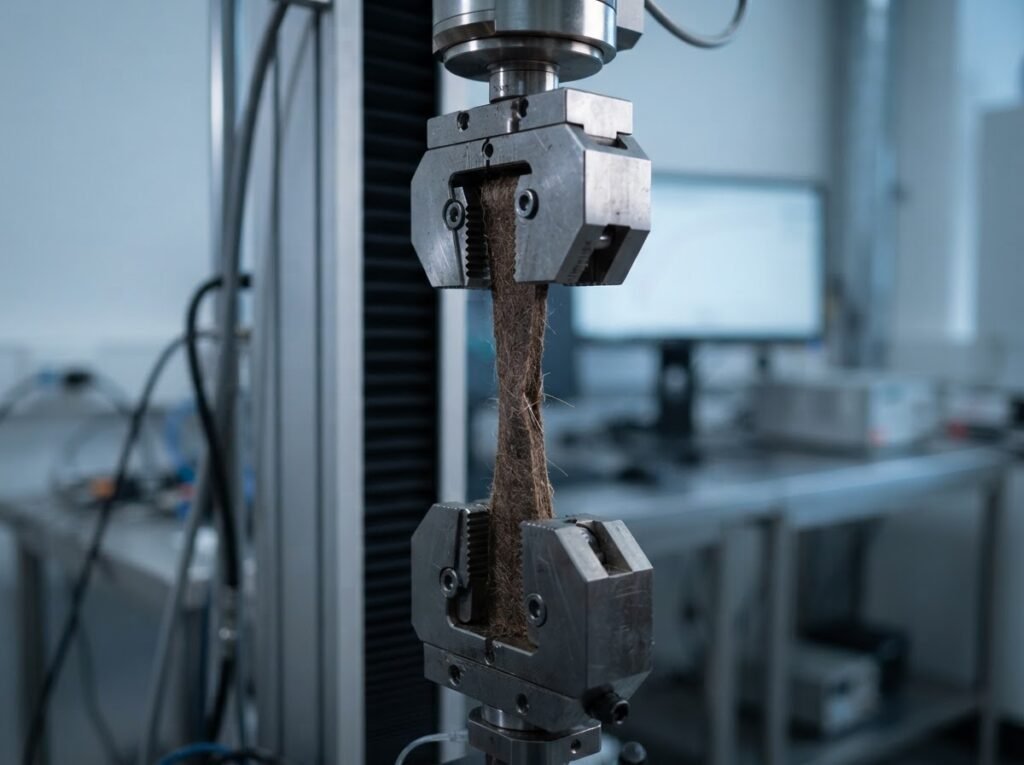
Thermal, acoustic, mechanical and moisture testing against named standards including ISO 8302, ASTM C518, ISO 10534-2, ASTM D792 and ASTM D7334.
Validation against application-level acceptance criteria, defined jointly with the partner before testing begins.
Long-horizon development of new platforms, including institutional research programmes such as the NITRA work behind Closed Cell™.
Material testing
Every published figure in the Tenzyle portfolio is tied to the standard it was measured against. Where testing has not been completed, the parameter is recorded as specification to be provided rather than estimated.
Test standards applied
Additional standards are applied per application. Test programmes for market-specific compliance — fire, emissions, durability — are scoped with the partner.
Technical validation
Validation is separate from characterization. Characterization establishes what a material does; validation establishes whether that is sufficient for a defined use.
Closed Cell™ Milkweed was characterized over nearly two decades with the Northern India Textile Research Association (NITRA), under the Ministry of Textiles’ National Technical Textiles Mission Project.
Thermal, acoustic, density and surface properties are measured against named international standards. A value without a method is not published.
Application-level validation criteria are agreed with the partner before testing begins, so the result is a pass/fail against their specification rather than a generic claim.
Every platform carries an explicit status — Full TDS Available, In Validation, or Enterprise Engagement — so an engineering team knows what evidence exists before they specify.
New material development
Some platforms cannot be developed on a project timeline. Closed Cell™ is the clearest example in the portfolio: nearly two decades of institutional characterization work moved Calotropis gigantea floss from a wild botanical to a trademarked, technically recognised commercial fiber.
That programme is the template for how Tenzyle approaches new feedstocks — a research question first, a commercial platform only once the evidence supports it.
Development programme
~20yr
Characterization programme with the Northern India Textile Research Association (NITRA), under the Ministry of Textiles’ National Technical Textiles Mission Project.
Institution
NITRA
Programme
National Technical Textiles Mission Project
Outcome
Closed Cell™ — trademarked fiber platform
R&D questions
A Technical Data Sheet (TDS) is a document listing a material’s measured properties, the test standard each value was measured against, and the conditions of the test. A TDS is what allows an engineering team to specify a material. Tenzyle publishes a TDS only for platforms where testing is complete.
In Validation means characterization and testing work is in progress for that platform and performance values have not yet been finalised. Technical data for platforms in validation is shared on request under a technical engagement, with the state of the work made explicit.
Natural fiber composites are materials in which a natural fiber provides the reinforcement phase within a polymer matrix. Composite performance is a laminate property — it depends on the fiber, the matrix, the fiber orientation and the processing route — so Tenzyle validates at laminate level rather than deriving part performance from fiber values alone.
Material validation is the process of confirming that a material meets defined acceptance criteria under the conditions of its intended application. It differs from characterization, which establishes what a material’s properties are. Validation establishes whether those properties are sufficient for a specific use.
R&D enquiry
Joint development, characterization support and validation programmes are run under R&D partnership agreements.