HomeApplicationsPackaging

Application — Packaging

Protective performance from a fiber, not a polymer

Moulded protective formats and cushioning layers for products that need protection without a synthetic foam.

Section 01

The application challenge

Protective packaging has to absorb energy, resist moisture and survive handling — then be disposed of, usually immediately. The performance requirement is short-lived; the material consequence is not.

Expanded synthetic foams remain the incumbent because they are cheap, light and predictable. Fiber-based alternatives have to match the protective function at comparable mass and comparable line speed.

Regulatory pressure and brand commitments are moving faster than the material options available to packaging engineers.


Section 02

Our material approach

Tenzyle states measured values and their test standards. Application-level performance is validated with the partner rather than claimed in advance.

Tenzyle evaluates fiber platforms for packaging on cushioning behaviour and bulk density first, then on moisture tolerance and process compatibility.

Hollow-lumen and coarse durable platforms are assessed for moulded protective formats; natural latex is evaluated where elastic recovery rather than single-impact absorption is the requirement.

Formats are developed against the partner’s forming process. Packaging is a volume business, so a material that cannot run at line speed is not a solution.

Section 04

Performance considerations

Only attributes relevant to this application and supported by available characterization are listed.

Weight

Low bulk density is critical where packaging mass directly affects shipping cost.

Durability

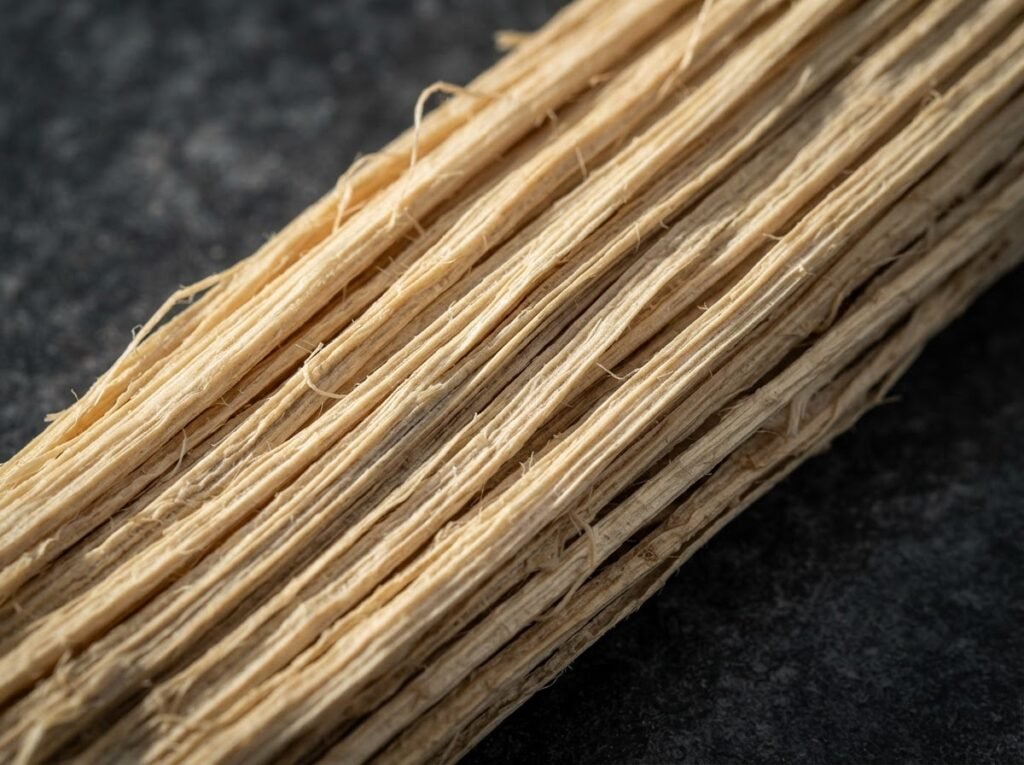
Coir and bast platforms are assessed for handling and abrasion resistance.

Flexibility

Natural latex is evaluated where repeated elastic recovery is required.

Process compatibility

Forming behaviour at production line speed is a validation requirement.

Section 05

Potential use cases

Use-case categories under evaluation. Tenzyle does not present these as confirmed commercial deployments.

01

Moulded protective inserts

Formed fiber trays and corner protection for transit packaging.

02

Cushioning layers

Energy-absorbing layers within multi-part protective assemblies.

03

Void fill and wrap

Bulk fiber formats replacing loose-fill synthetic products.

04

Thermal transit packaging

Insulating liners for temperature-sensitive shipments.

Section 06

Technical validation

Available testing and validation information for this application area.

Kapok density and hydrophobicity are characterized against named standards.

Coir, bast and banana platforms are in validation — no performance values are published for these platforms yet.

Protective performance is validated per pack format against the partner’s drop and compression criteria.

Section 07 — Technical brief

Request a technical brief for packaging

Share the performance requirement, the process constraint and the target format. We respond with a platform assessment and a proposed validation route.

Application questions

Applying natural fiber materials

What are the applications of natural fiber materials?

Tenzyle works across seven application areas: automotive, packaging, construction, technical textiles, insulation, composites, and wider industrial applications. Platform selection differs by application — hollow-lumen fibers where thermal and acoustic performance at low mass govern, and bast fibers where tensile reinforcement governs.

Primarily in interior substrates, acoustic packages and semi-structural panels. Hollow-fiber platforms address thermal and acoustic functions at very low mass; hemp-based reinforcement is evaluated for load-path components currently specified in glass-fiber reinforced polymer. Part-level validation is defined jointly with the OEM against their acceptance criteria.

Tenzyle publishes use-case categories rather than commercial deployment claims. Where a platform has completed characterization, the measured values and test standards are stated. Application-level and part-level performance is validated with the partner during an engagement.

Anywhere a specification can be defined in measurable terms. If a requirement does not map to one of the seven published application areas, it is handled through the Custom Engineered Blends route, where the specification is the starting point for formulation.