HomeApplicationsIndustrial Applications

Application — Industrial Applications

Where the requirement does not fit an existing category

Filtration, geotextile, agricultural and process applications addressed through custom formulation.

Section 01

The application challenge

A significant share of industrial material requirements do not map onto a standard product category. The requirement arrives as a set of constraints — a density ceiling, a temperature range, a process speed — rather than a product name.

For those requirements, a catalogue is the wrong tool. What is needed is a formulation capability and a validation route.

Substitution also has to respect existing plant: a material that cannot run on the installed line is not a viable answer regardless of its properties.

Section 02

Our material approach

Tenzyle states measured values and their test standards. Application-level performance is validated with the partner rather than claimed in advance.

Tenzyle handles these requirements through the Custom Engineered Blends route: the specification is taken as the starting point, candidate platforms are screened, a blend is formulated and then validated against the partner’s acceptance criteria.

Process constraints are captured at the start of the engagement, so formats are engineered for the partner’s existing equipment rather than requiring new capital.

Each engagement produces a specification and data package specific to that application.

Section 04

Performance considerations

Only attributes relevant to this application and supported by available characterization are listed.

Process compatibility

Existing line constraints are captured before formulation begins.

Durability

Service-life behaviour under the partner’s operating conditions is a defined validation item.

Weight

Density targets are treated as a formulation input where mass is constrained.

Thermal performance

Where a thermal figure is specified, platform selection is driven by measured conductivity.

Section 05

Potential use cases

Use-case categories under evaluation. Tenzyle does not present these as confirmed commercial deployments.

01

Filtration media

Nonwoven web constructions for industrial filtration functions.

02

Geotextiles

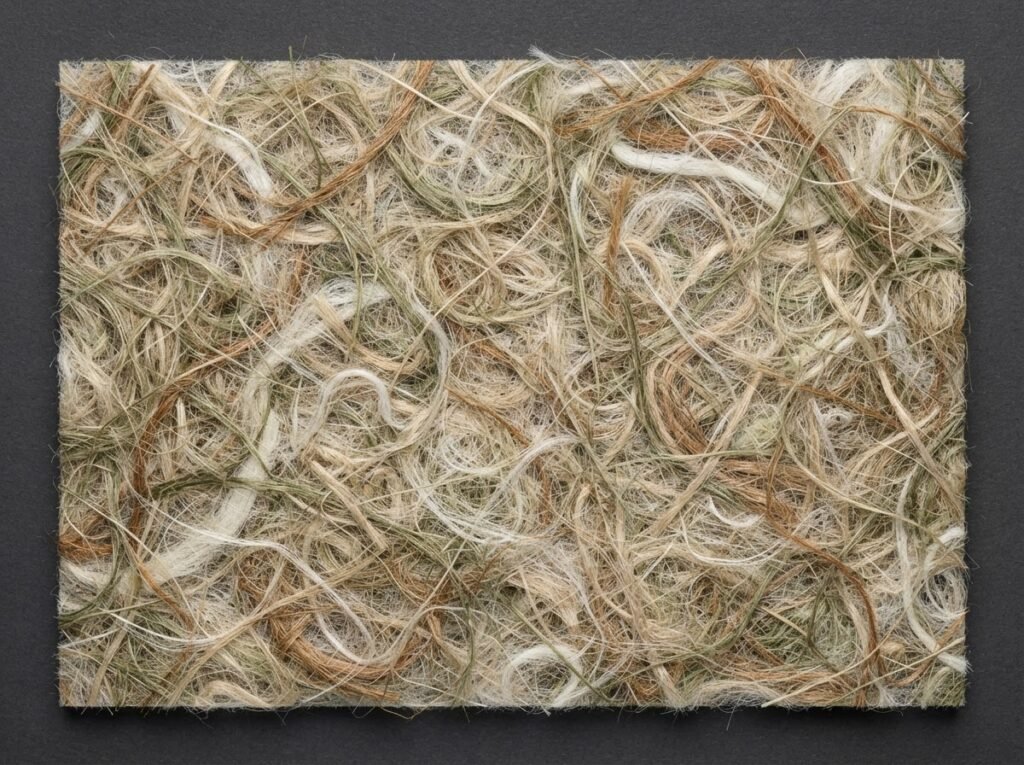
Coarse durable fiber matting for ground stabilisation and erosion control.

03

Agricultural substrates

Growing media and mulch matting formats.

04

Process consumables

Wipes, absorbents and protective layers in industrial processes.

Section 06

Technical validation

Available testing and validation information for this application area.

Validation criteria are defined jointly with the partner at the start of the engagement.

Platform-level data is available for characterized materials; blend data is generated per engagement.

Technical data available on request under technical engagement.

Section 07 — Technical brief

Request a technical brief for industrial applications

Share the performance requirement, the process constraint and the target format. We respond with a platform assessment and a proposed validation route.

Application questions

Applying natural fiber materials

What are the applications of natural fiber materials?

Tenzyle works across seven application areas: automotive, packaging, construction, technical textiles, insulation, composites, and wider industrial applications. Platform selection differs by application — hollow-lumen fibers where thermal and acoustic performance at low mass govern, and bast fibers where tensile reinforcement governs.

Primarily in interior substrates, acoustic packages and semi-structural panels. Hollow-fiber platforms address thermal and acoustic functions at very low mass; hemp-based reinforcement is evaluated for load-path components currently specified in glass-fiber reinforced polymer. Part-level validation is defined jointly with the OEM against their acceptance criteria.

Tenzyle publishes use-case categories rather than commercial deployment claims. Where a platform has completed characterization, the measured values and test standards are stated. Application-level and part-level performance is validated with the partner during an engagement.

Anywhere a specification can be defined in measurable terms. If a requirement does not map to one of the seven published application areas, it is handled through the Custom Engineered Blends route, where the specification is the starting point for formulation.